



What guests are saying
What guests love
- A central Loop location inside a 1905 landmark — walkable to Willis Tower, the river, the financial district, and the theaters.
- Dependable full-service comforts in a beautifully adapted historic tower.
- Solid value for a landmark address in the heart of downtown.
What to keep in mind
- A full-service chain hotel inside a landmark, not a boutique property
- Busy area; rooms vary by floor and view
Best for Travelers who want a comfortable, reliable base in a landmark building, central to the Loop, Willis Tower, and the theatre district.
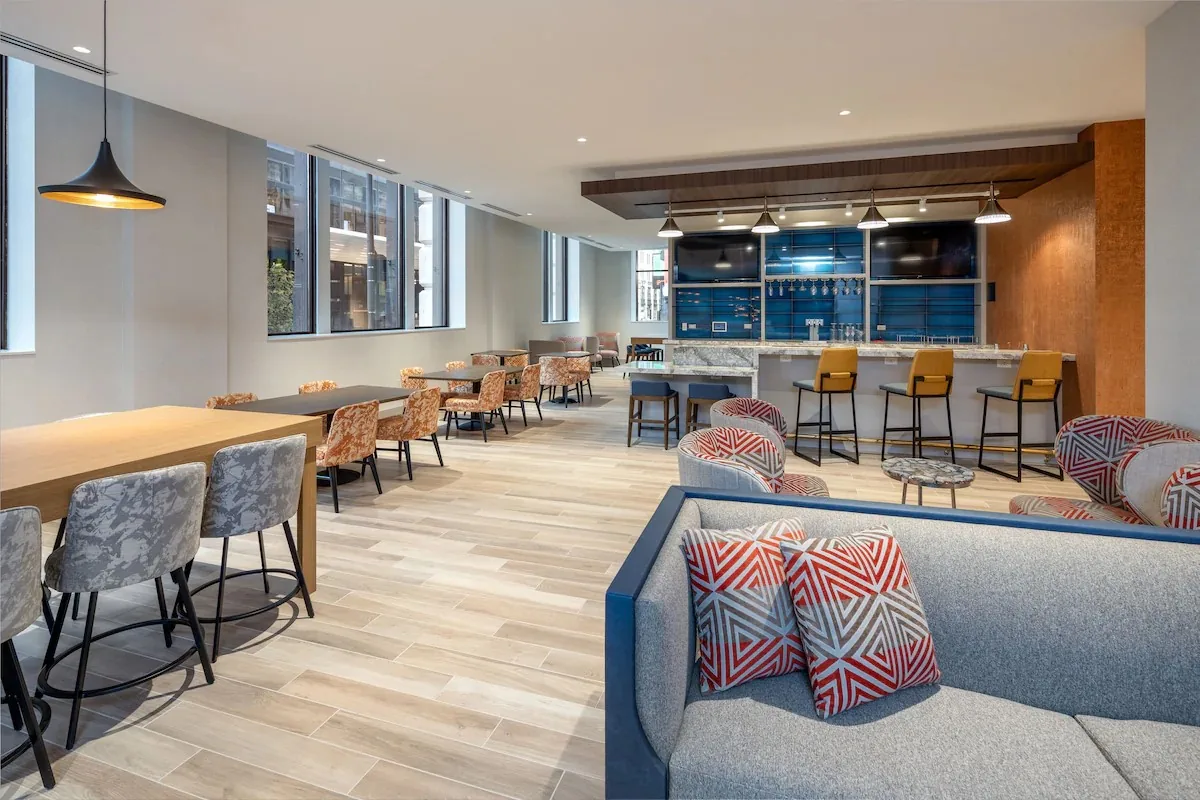
Summary of guest reviews. Sources: Hilton Garden Inn Chicago Central Loop, Commission on Chicago Landmarks, Preservation Chicago. Photography courtesy of Hilton Garden Inn Chicago Central Loop, used with permission. Designation report: Chicago and North Western Railway Office Building (L-358) at Chicago Landmark Reports. Details may change over time.
Why this building matters
The hotel shares the former Chicago & North Western Railway Office Building with the Canopy by Hilton — a fourteen-story Classical Revival tower completed in 1905 by Frost & Granger as the railroad's headquarters, and later home to the City Colleges of Chicago. Preservation Chicago worked with the developer to embrace the building's historic character and helped secure its 2020 Chicago Landmark designation, which made the adaptive reuse possible. The Hilton Garden Inn occupies upper floors, addressed on the Franklin Street side.
The National War Agencies Building
The Chicago & North Western moved out in 1929, only twenty-four years after moving in, decamping to the new Daily News Building on West Madison so it could sit beside its own terminal. It kept the deed but not the occupancy, and through the 1930s this granite headquarters stood largely empty — there was simply not the demand for Loop offices. By 1939 the railroad had put it in the hands of an agent to sell or lease.
What filled it was the war. In 1942 the federal government took a lease on the entire building and moved war-department offices in from the Civic Opera Building: the Office of Price Administration, the Office of War Information, the War Production Board. Three hundred thousand dollars went on washing the granite and overhauling the plumbing and elevators, and the building was renamed the National War Agencies Building.
It was not an orderly occupation. The Chicago Daily Tribune reported that the new war offices refused to stay where they had been put, shifting from floor to floor as their needs changed, with partitions going up and coming down behind them.
In 1950 the railroad finally sold, for $900,000, to the industrialist Henry Crown. A permit filed four years later for work along the parapet is the likely moment the building lost its original cornice. Then came a spell leased to Continental Illinois in the 1970s, and from 1978 a long second career as the headquarters of the City Colleges of Chicago, which held it into the 2010s.
So the count runs: twenty-four years as a railroad headquarters, a decade nearly empty, the war, a tycoon, thirty-odd years of community colleges, and now two hotels. This one shares the building with the Canopy by Hilton Central Loop.
What the railroad built
The building went up in 1904–05 for the Chicago & North Western, the largest railroad in the Midwest — in 1904 alone it carried over 21 million passengers nationally and 11 million commuters around Chicago. Fourteen stories of steel clad in light-gray granite, composed like a classical column with a two-story base, a ten-story shaft and a two-story capital, and entered between two fluted Doric columns on Jackson Boulevard.
Its architects, Frost and Granger, were brothers-in-law who had both married daughters of the railroad’s president — which is one explanation for why they designed some eighty C&NW stations and depots between 1900 and 1910. Look for the light court cut into the east side: it is what gives the upper floors their C-shaped plan, and it was there to get daylight to clerks working before electric lighting was any good.
Drawn from the building’s Chicago Landmark designation report. Read the report →
Explore more like this
more historic hotels near Millennium Park · Beaux-Arts hotels in Chicago