







What guests are saying
What guests love
- Sweeping Grant Park and lakefront views from a genuine mid-century tower.
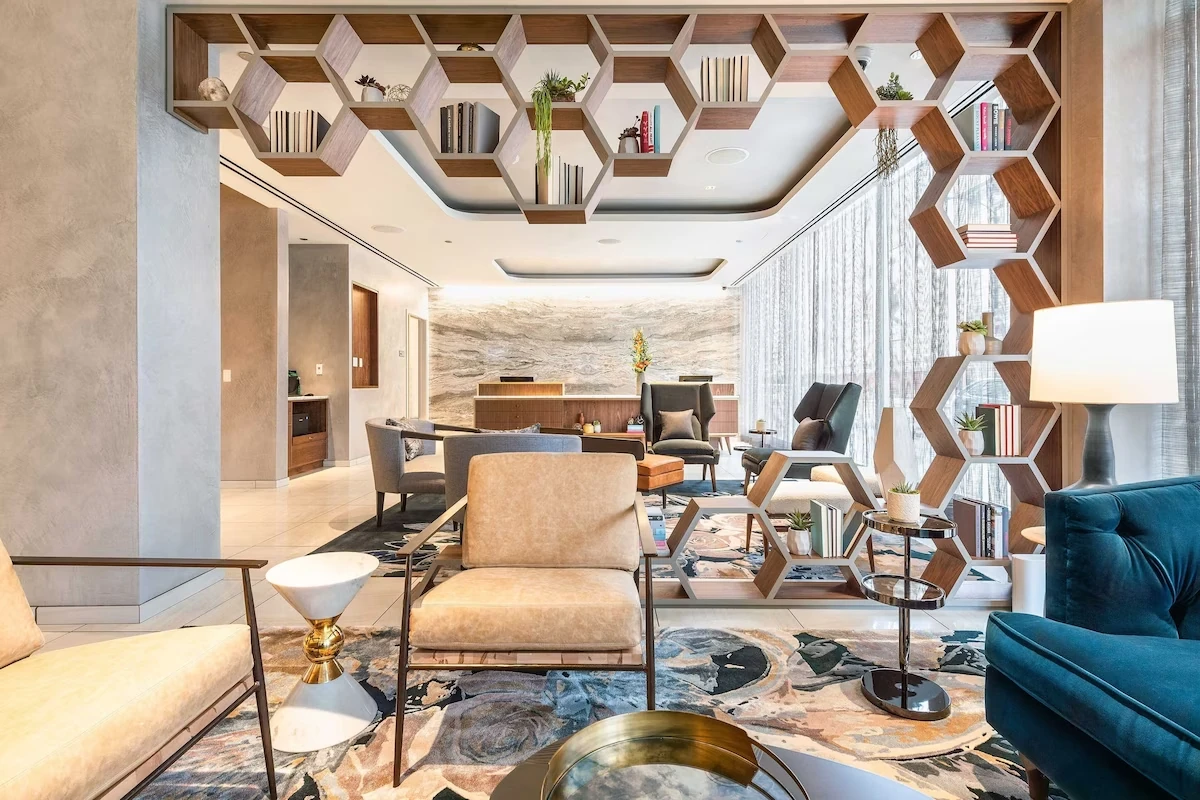
- A design-forward revival with a stylish lobby bar and on-site dining.
- A South Loop address on Michigan Avenue overlooking Buckingham Fountain and Grant Park, a 12-minute walk to the Art Institute.
What to keep in mind
- A mid-century tower — an aesthetic distinct from the masonry classics nearby
- A busy Michigan Avenue stretch
Best for Lovers of mid-century design and skyline-and-park views who want a stylish, well-located South Loop base.
Summary of guest reviews. Sources: Le Meridien Essex Chicago, Commission on Chicago Landmarks, Preservation Chicago. Photography courtesy of Le Méridien Essex Chicago, used with permission. Designation report: Essex Inn (L-339) at Chicago Landmark Reports. Details may change over time.
Why this building matters
Completed in 1961 to the designs of A. Epstein & Sons, the Essex Inn is one of the few International Style towers along Michigan Avenue, a crisp glass-and-steel counterpoint to the masonry classics of the Historic Michigan Boulevard District. It was named a Chicago Landmark in 2016, with its rooftop “ESSEX INN” sign expressly protected. A full revitalization reopened it as Le Méridien in 2021.
When Chicago stopped building hotels
Here is a fact that reframes this building entirely. Between the Crash of 1929 and the end of the 1950s, exactly one hotel was built in downtown Chicago — the Executive House on Wacker Drive, in 1958. Thirty years, one hotel.
What was being built instead were motels. They went up around the edges of the city and then, increasingly, inside the Loop itself, and they sold themselves on being somewhere else: names like the Breakers, the Sands, the Tides and the Tropicana, with architecture that the designation report notes “would not have been out of place in California or Florida.” Above all they sold newness, against a downtown hotel stock that was by then several decades old.
The Essex was built by a company called Aristocrat Inns of America, run by Martin Gecht and Eugene Heytow, who put up three of these within a few blocks of each other on South Michigan — the Avenue Motel at Roosevelt, since demolished, the Ascot at 1100 South Michigan, now a Best Western, and this one, which was the biggest bet of the three. Asked what made a motel work, they gave a one-word answer: location. “That’s why the motels are going up on Michigan Avenue.”
And they picked this particular spot for a reason that still shapes the experience. It sits next door to what was then the Conrad Hilton — now the Hilton Chicago — deliberately, to catch travelers who wanted to be in the middle of everything but did not want the formality of a grand hotel.
Wake-up coffee and the first pool on Michigan Avenue
Ground was broken on March 14, 1960, with Mayor Richard J. Daley there to speak. What opened the following year was fourteen stories of glass and aluminum with 285 rooms, a restaurant, a cocktail lounge, a parking structure for two hundred cars — and the first outdoor swimming pool on Michigan Avenue. The whole thing cost six million dollars, something like forty-eight million now.
The advertising is a period piece in itself. Rooms were air-conditioned and soundproofed. The telephones were self-dialing. And every room came with what the copy called “wake-up coffee.” The pitch ran on proximity: Grant Park and the lake outside, McCormick Place and the convention halls close by, theaters and museums within reach.
Architecturally it is the cleanest International Style building in this guide — a box with its frame showing, smooth surfaces, no ornament at all, a curtain wall of glass and enameled spandrel panels. The designation report calls it a superior example of the glass-box Modern that arrived in Chicago with the postwar boom, and it is listed as an associated building in the post-war context statement for the Historic Michigan Boulevard District.
It is worth pausing on what that means. Most of the hotels in this guide were landmarked for being old. This one was landmarked for being new — for documenting the moment the interstate and the convention trade rewrote how Americans traveled, and for being a very good example of the architecture that moment produced.
Drawn from the building’s Chicago Landmark designation report. Read the report →