






What guests are saying
What guests love
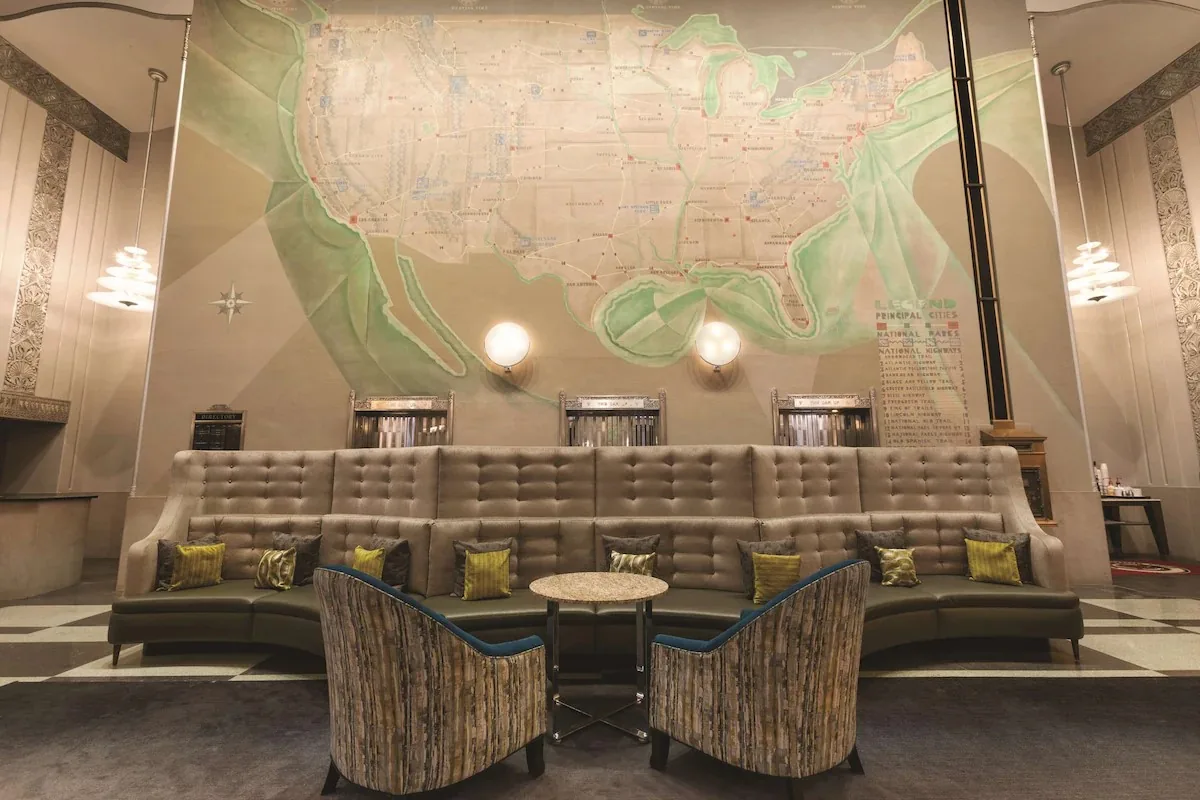
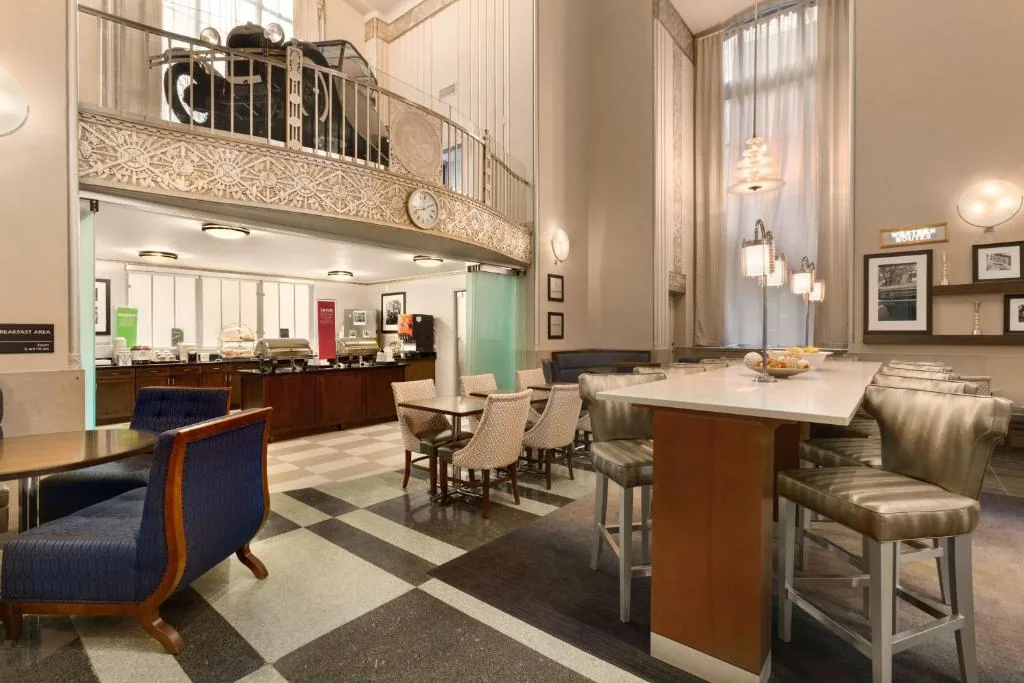
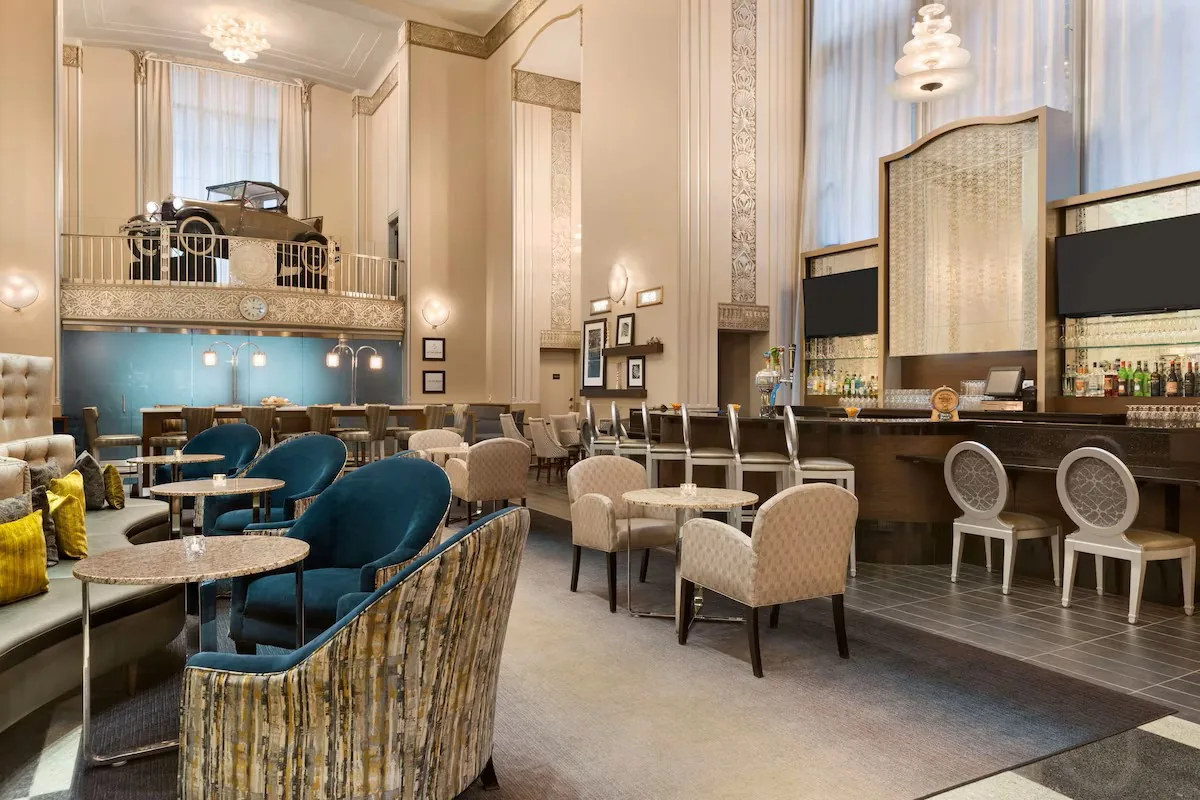
- The lobby is the headline — a soaring Art Deco room with a restored mural of the U.S. highway system and a period Ford Model A, instantly transporting you to 1928.
- A quiet, central Loop address on Wacker Place, steps from the Chicago River, the Riverwalk, and Michigan Avenue.
- Genuine landmark character at an approachable price — a rare combination downtown.
What to keep in mind
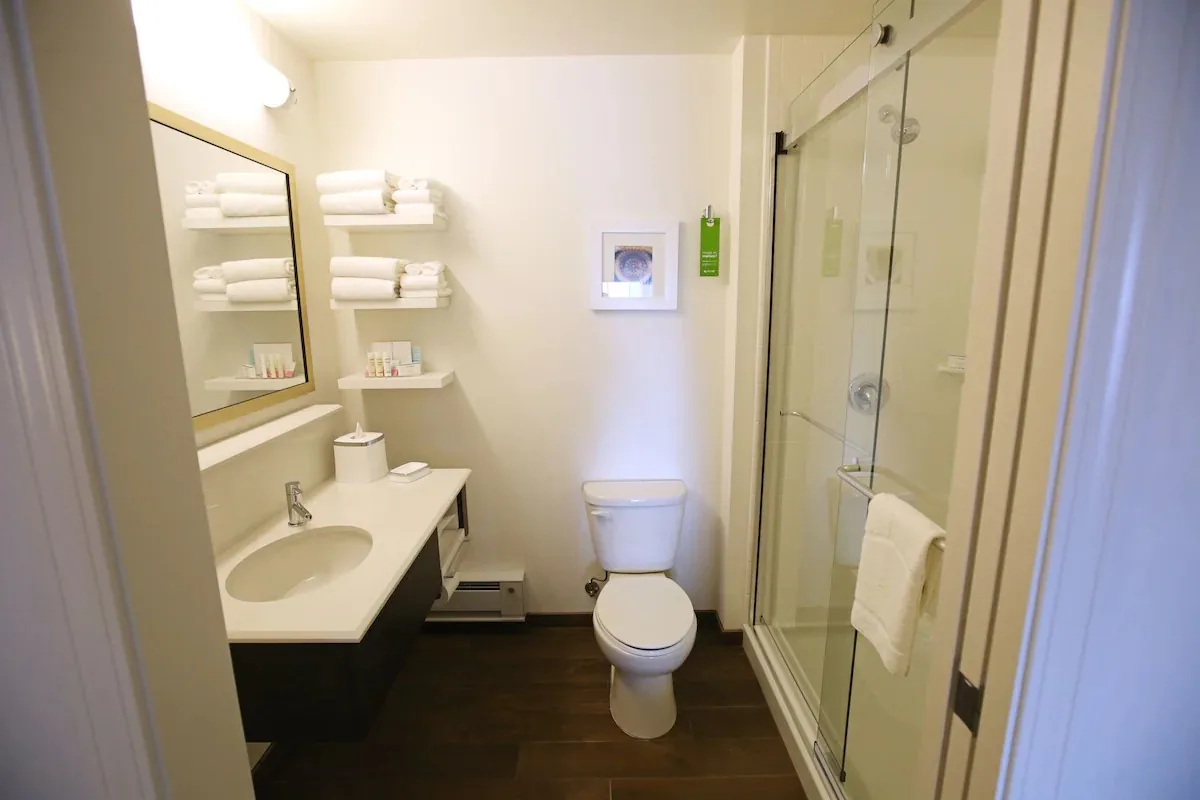
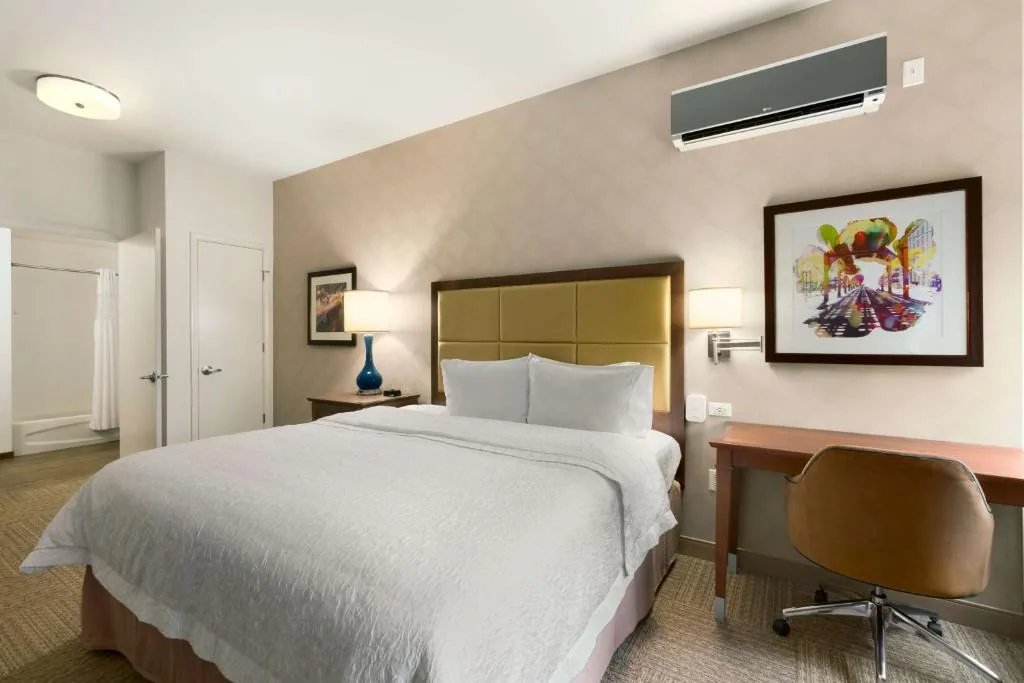
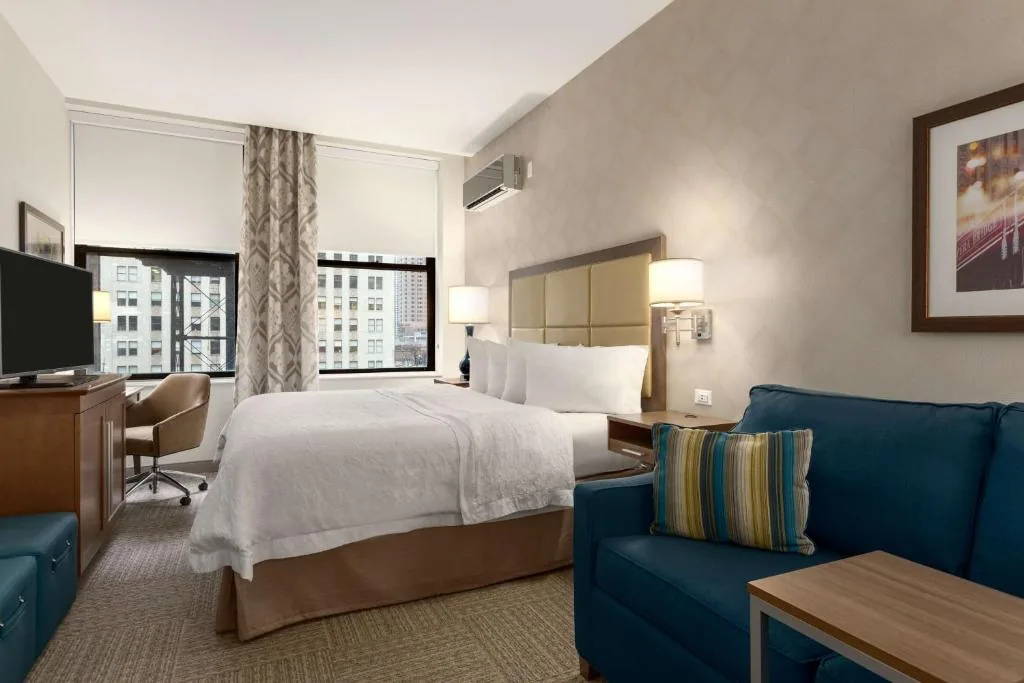
- A 1928 tower: rooms are comfortable but on the compact side
- Brand-hotel rooms; the magic is in the historic public spaces
Best for Travelers who love Art Deco and want a genuine landmark stay without a luxury price — and anyone who’d enjoy a lobby that doubles as a little museum of the early automobile age.
Summary of guest reviews. Sources: Chicago Motor Club, Commission on Chicago Landmarks, Preservation Chicago. Photography courtesy of Hampton Inn Chicago Downtown/N Loop/Michigan Ave, used with permission. Designation report: Chicago Motor Club Building (L-312) at Chicago Landmark Reports. Details may change over time.
Why this building matters
Designed in 1928 by the celebrated firm Holabird & Root, the Chicago Motor Club Building is one of the Loop’s great Art Deco skyscrapers — and for decades it served the motoring public in the early age of the automobile. After sitting vacant, it was carefully restored and reopened as a hotel in 2015, preserving its showpiece lobby: a dramatic two-story space with a restored 1920s mural mapping the nation’s highways, and a vintage Ford Model A on display. It’s one of Chicago’s most charming examples of a landmark rescued through adaptive reuse.
The club that gave America the school safety patrol
The Chicago Motor Club was founded in 1906, back when owning a car made you a curiosity. Its members had been at it a decade before this building went up, and they were not simply enthusiasts — the club set out to be taken seriously, advocating for motorists and pushing for what it called good roads. In its first year it was already leaning on the mayor to enforce an ordinance requiring vehicles to carry lights after dark.
Its lasting contribution is one most Americans have seen without knowing where it came from. In 1920 the Chicago Motor Club established the School Safety Patrol — the program that puts older children on corners to shepherd younger ones across the street. It spread nationwide, was given a Presidential Citation in 1985, and is still running today.
The club also ran what may be the ancestor of every roadside rescue since. For fifteen dollars a year in the 1920s, a member whose car died by the roadside could expect, within fifteen to thirty minutes, one of the club’s “khaki clad mechanics mounted on fleet white motorcycles… ready to rush to the aid of member at any hour of the day or night.” The club joined the American Automobile Association in 1914, and it is still AAA today.
How fast all this arrived is easy to underestimate. Chicago saw its first automobile in 1892. On Thanksgiving Day 1895 the Chicago Herald staged what it billed as America’s first automobile race, a 52-mile round trip from Jackson Park to Evanston and back; the winner took just under eight hours, averaging 6.7 miles an hour. In 1900 roughly one Chicagoan in ten thousand could afford a car. Thirty years later there was one for every eight people in the city.
Requests to the club’s touring bureau tell the same story in miniature: 1,816 in 1919, 9,199 in 1920, and 51,211 by 1921.
A map you can stand under
The lobby is the reason to walk in even if you are not staying. It rises three stories through almost the whole ground floor, reached through a deliberately low, small vestibule so the space opens above you all at once — and the designation report calls it one of the finest Art Deco interiors in Chicago.
Above the elevators is a painted map of the United States showing the main automobile routes across the country as they stood in 1928. The club described it, pleasingly, as “as useful as it is decorative.” It is the work of John Warner Norton, who ran the mural department at the School of the Art Institute for nineteen years and had earlier prepared mural studies for Frank Lloyd Wright at Midway Gardens. Alcoves along the opposite wall once held racks of touring pamphlets for members planning a trip.
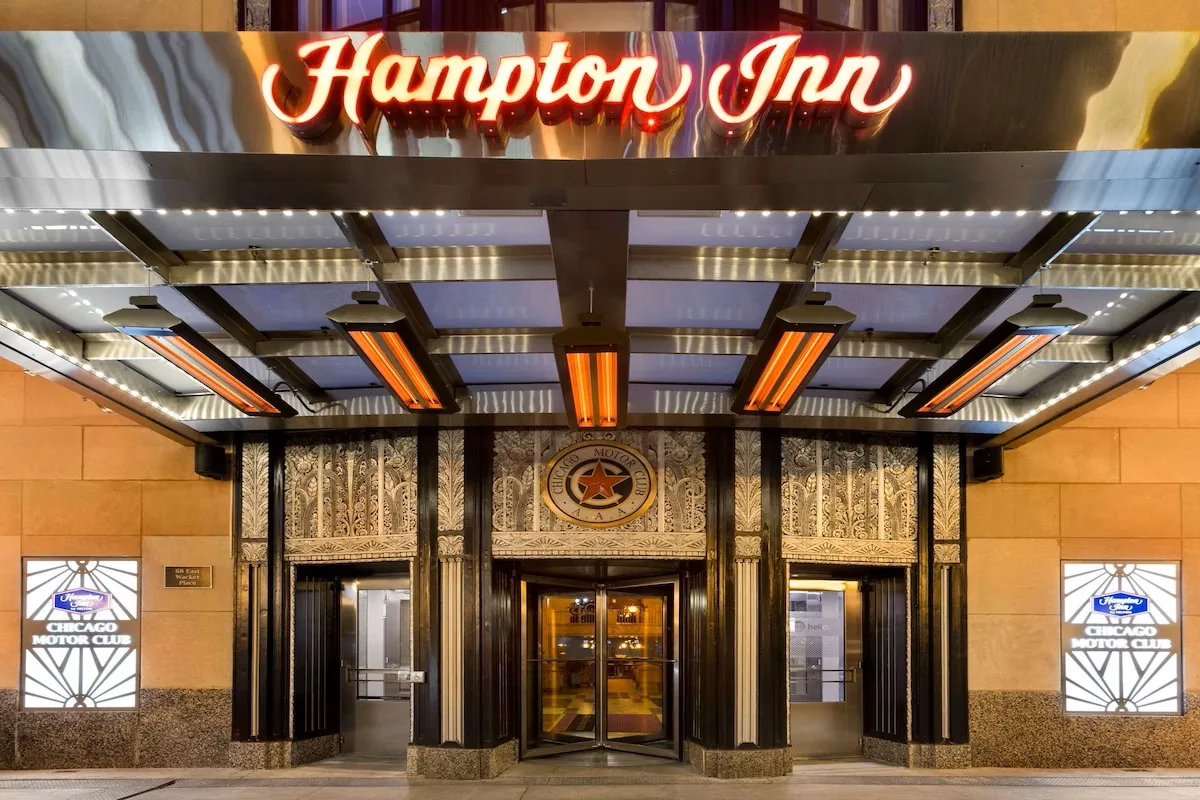
The building itself is a quiet lesson in Chicago zoning. Tall towers of the late 1920s had to step inward as they rose under the city’s 1923 ordinance; this one was small enough to be exempt, so it simply goes straight up, which is why it reads as so much more vertical than its fifteen stories suggest. Look at the base for the cast-iron entrance surround — stylized flowers, fountains of water, zigzags and sunbursts — and the club’s own insignia carved into the stone.
AAA moved out to Aurora in 1985. Commercial tenants came and went, several redevelopment schemes were floated and abandoned, and from 2004 the building stood empty for more than a decade before reopening as a hotel.
Drawn from the building’s Chicago Landmark designation report. Read the report →
What the club actually lobbied for
The club’s campaigning had a specific target. Daniel Burnham and Edward Bennett’s Plan of Chicago of 1909 proposed a set of improvements to carry the growing number of automobiles through the central business district, and the designation report credits the Chicago Motor Club with a major local role in lobbying to get them built.
The problem was real and the report is blunt about it. Cars leaving the showrooms on Motor Row “were often forced to contend with deeply rutted streets and fierce competition with streetcars, horse-drawn carriages and commercial traffic for a share of the road.” The club put its weight behind the plan that proposed to fix it, and then built its headquarters on E. Wacker Place, a few steps west of N. Michigan Avenue, in the middle of the district it had spent two decades arguing about.
Holabird & Root, and the fathers behind the name
The firm that designed this building was two sons carrying on a practice. Holabird & Root was the successor to Holabird & Roche, and when its founders died — William Holabird in 1923, Martin Roche in 1927 — control passed to John A. Holabird, William’s son, and John W. Root Jr. Root’s father had founded Burnham & Root with Daniel Burnham, which is how Burnham reaches this building twice: once through the plan the club lobbied for, and once through the drawing board.
The two younger men met in the 1910s as students at the École des Beaux-Arts in Paris. They worked briefly at Holabird & Roche before the First World War, served, and came back. From the mid-1920s, before the office was even reorganized under their own names in 1928, the report says the work “began to take on a very contemporary character, largely in response to Chicago’s adoption of a new zoning ordinance in 1923” — and the firm became key to the development of the setback skyscraper in Chicago and beyond. This building, exempt from those same rules, rises without a single setback.
Their other work is a list of the skyline: the Chicago Board of Trade Building, 333 N. Michigan Avenue and the Palmolive Building, all Chicago Landmarks, along with the Chicago Daily News Building.
Worth stepping inside for
Look up in the first-floor lobby: the 1928 mural United States Map is protected along with the building’s exterior.
Explore more like this
more 1920s & Jazz Age hotels · more historic hotels near Millennium Park